5G Deep DiveSingapore Mobile, Decoded.

Everything You Need to Know About 5G in Singapore

This is your complete guide to 5G in Singapore — from the technical foundations every consumer should understand, to the real differences between NSA and SA network architectures being rolled out by Singtel, StarHub, M1, and TPG. We break down mmWave vs Sub-6GHz spectrum, share real-world speed benchmarks tested across Singapore's districts, and explain exactly what all of this means for your daily mobile experience — whether you're streaming, gaming, or just trying to pick the best SIM plan.

12
In-depth Articles
~47 min
Total Reading Time
4 Topics
NSA · SA · mmWave · Sub-6GHz
Live Data
Real-world Speed Tests
Scroll to explore
5G Explainers

Deep Dives Worth
Your Time

Long-form, technically rigorous explainers on Singapore's 5G ecosystem — no fluff, no recycled press releases.

How Singapore's 5G SA Core Works
Network Architecture

How Singapore's 5G SA Core Works

Singapore's 5G Standalone (SA) core network represents a fundamental departure from the non-standalone (NSA) architecture that dominated the early rollout years. Unlike NSA, which piggybacks on existing 4G LTE infrastructure for control functions, SA runs an entirely cloud-native 5G core — enabling the full suite of next-generation capabilities that operators have been promising since the spectrum was awarded.

W

Wei Liang Tan

12 Jun 2025

8 min readRead article
mmWave vs Sub-6GHz: What Matters for You
Radio Technology

mmWave vs Sub-6GHz: What Matters for You

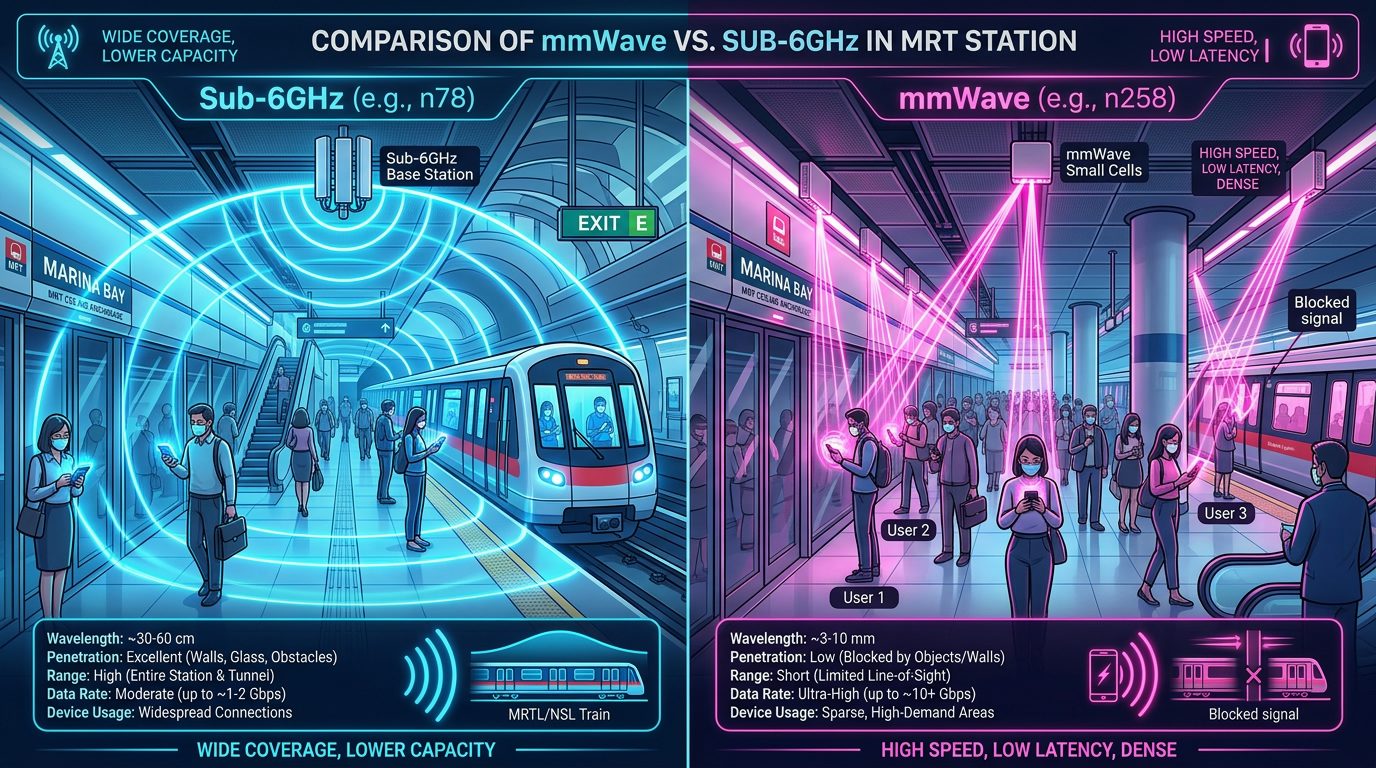
Walk into a conversation about 5G and you'll inevitably hit two terms that sound like they belong in a physics lecture: mmWave and Sub-6GHz. Both are 5G. Both use the same 5G NR standard. But the experience they deliver — and the situations where you'll actually encounter them in Singapore — couldn't be more different.

P

Priya Nair

28 May 2025

6 min readRead article
Singtel vs StarHub 5G Coverage Map 2025
Operator Comparison

Singtel vs StarHub 5G Coverage Map 2025

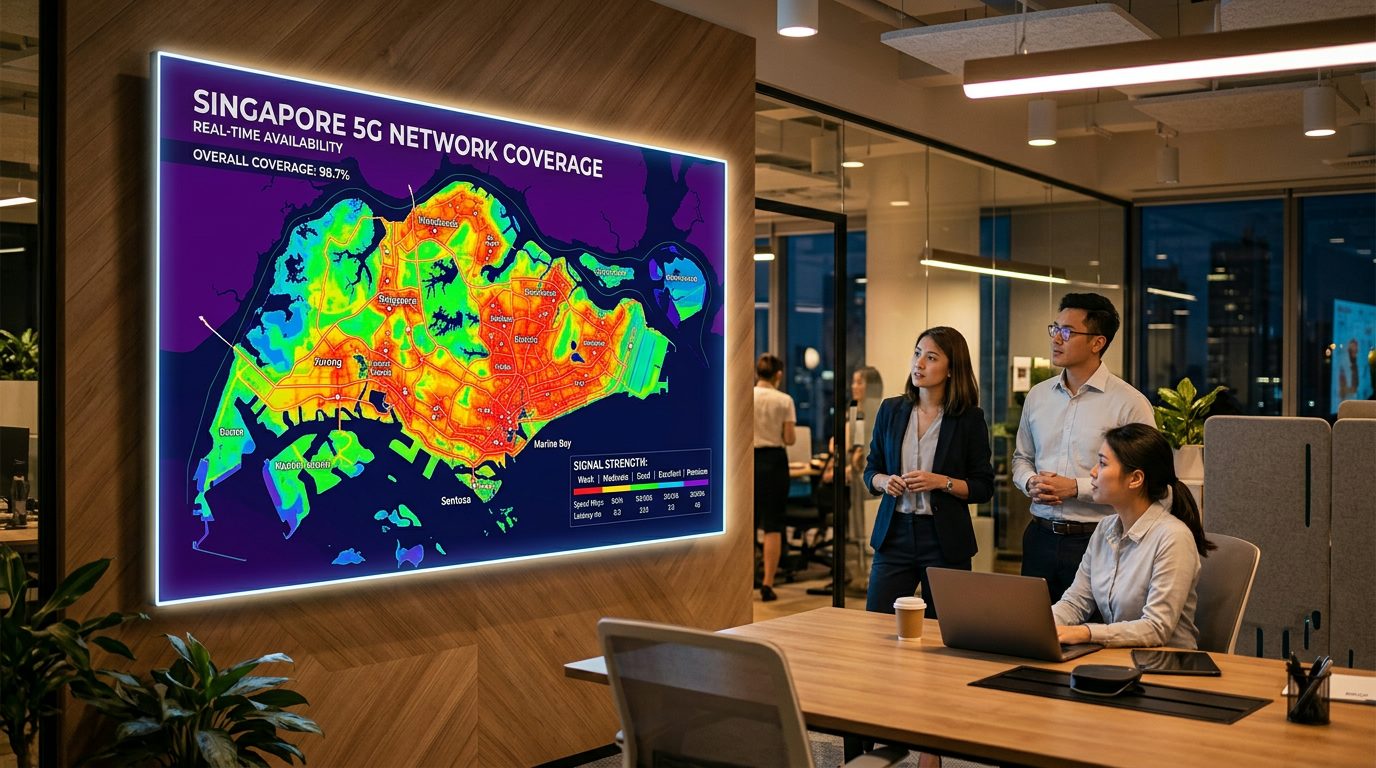
Singapore's 5G landscape in 2025 is a two-horse race — and the gap between those horses has narrowed considerably since the initial rollout years. Singtel operates its own standalone 5G network, while StarHub and M1 jointly built theirs under the TPVJV (TPG-StarHub-M1 joint venture) framework, with each operator maintaining its own brand and customer relationship on top of the shared infrastructure.

M

Marcus Ong

5 Jun 2025

10 min readRead article
5G and Singapore's Smart Nation: Real Use Cases, Not Hype
Smart Nation

5G and Singapore's Smart Nation: Real Use Cases, Not Hype

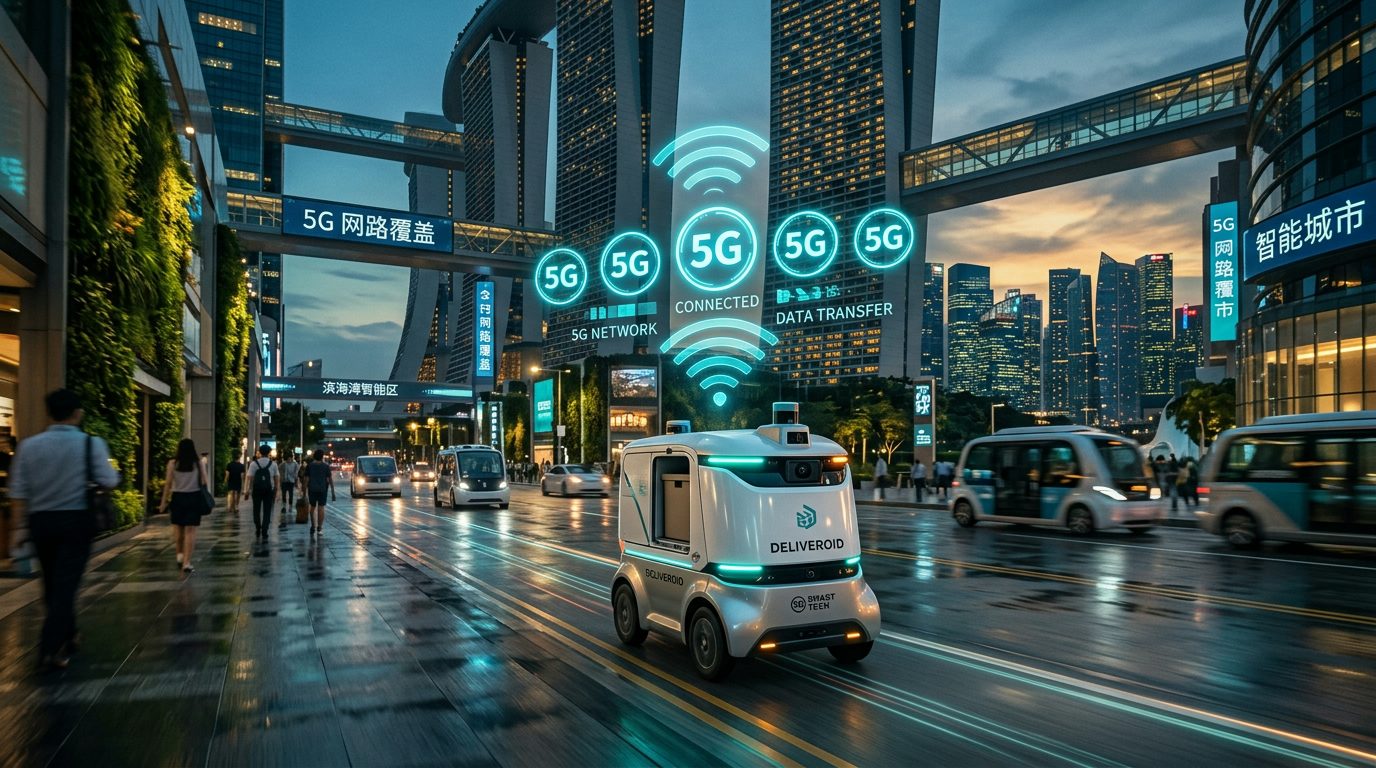
Every 5G press release promises to revolutionise industries, transform cities, and unleash the fourth industrial revolution. Most of it is marketing. But Singapore is genuinely one of the handful of places on Earth where 5G-enabled applications have moved from proof-of-concept to operational deployment — and the gap between hype and reality is worth examining honestly.

A

Aisha Binte Rashid

19 Jun 2025

7 min readRead article

More 5G explainers added every week — no login required.

Quick Reference

5G Glossary12 Terms, Plain English.

Cut through the jargon. Every key 5G concept — explained simply, with real Singapore context. Tap any term to expand.

NSA 5G piggybacks on existing 4G LTE infrastructure for control signals while using 5G New Radio for data. It's the faster, cheaper way to launch 5G without replacing everything at once.

SG Context:When Singtel first rolled out 5G in Singapore in 2021, it used NSA mode — meaning your phone used 4G to connect to the network, then switched to 5G channels to download at speed.

SA 5G runs entirely on a native 5G core network — no LTE crutch needed. It unlocks the full potential of 5G including ultra-low latency, network slicing, and advanced edge computing.

SG Context:StarHub's SA 5G rollout in Singapore enables features like live-event AR experiences at the Singapore Sports Hub that simply weren't possible on NSA networks.

Extremely high-frequency radio waves (24–100 GHz) that carry massive amounts of data at blazing speeds — often exceeding 4 Gbps. The catch: short range and poor building penetration.

SG Context:IMDA has allocated mmWave spectrum (26 GHz band) in Singapore for dense urban deployments. Expect mmWave hotspots inside Changi Airport Terminal 5 and major MRT interchanges.

Radio frequencies below 6 GHz used for 5G. Offers a practical balance of speed and coverage — faster than 4G but with a range that can penetrate HDB blocks and MRT tunnels.

SG Context:Singapore's three telcos — Singtel, StarHub, and M1 — all use the 3.5 GHz sub-6 band as their primary 5G layer to give island-wide coverage across HDB estates and industrial parks.

The 3GPP radio access standard that defines how 5G devices communicate with base stations. NR replaces LTE as the air interface for 5G, covering both sub-6 and mmWave frequencies.

SG Context:Your Samsung Galaxy S25 connects to towers via 5G NR. In Singapore, you'll see 'NR' displayed in your status bar instead of '5G' on some Android devices when connected.

Instead of broadcasting signals in all directions, beamforming focuses radio energy into a precise, targeted beam aimed directly at your device. Result: faster speeds, better range, less interference.

SG Context:At a packed Taylor Swift concert at the National Stadium, beamforming allows each phone to get its own directed signal — so 55,000 fans can stream simultaneously without the network collapsing.

Divides a single physical 5G network into multiple isolated virtual networks, each tuned for a specific use case — one slice for IoT sensors, another for video calls, another for autonomous vehicles.

SG Context:Singapore's Smart Nation initiative uses network slicing so that sensors monitoring water levels in Bishan-Ang Mo Kio Park don't compete for bandwidth with commuters streaming on the MRT.

A 5G service category designed for mission-critical applications requiring near-zero latency (< 1 ms) and 99.9999{e774d2e9a749e5bc707c745b1bdd514498e9be8fb774d5cdfc45c9726504a489} reliability. Failures are simply not an option.

SG Context:Singapore General Hospital is piloting URLLC 5G for remote surgical robotics — where a 1-millisecond lag is the difference between precision and disaster.

The most consumer-facing 5G service class, focused on delivering dramatically higher data speeds and capacity. Think 4K streaming, cloud gaming, and VR — all mobile.

SG Context:When you download a Netflix series on the MRT in under 30 seconds using Singtel 5G, that's eMBB at work — optimised for high-throughput everyday mobile use.

Moves computing power physically closer to the user — at the network edge rather than a distant data centre. This slashes latency and enables real-time applications that cloud computing alone can't support.

SG Context:Jurong Port uses MEC-powered 5G so that AI cameras analysing container movements get instant processing results on-site, not after a round-trip to a data centre in Tuas.

The time it takes for a data packet to travel from your device to a server and back. Measured in milliseconds (ms). Lower is better. 4G averages ~30–50 ms; 5G targets < 5 ms under ideal conditions.

SG Context:Cloud gamers on Singtel 5G playing Genshin Impact on GeForce NOW from Singapore servers typically see latency under 10 ms — a massive jump from 4G's 40 ms average.

The actual volume of data successfully transferred over a network in a given time period, usually measured in Mbps or Gbps. Distinct from speed — throughput reflects real-world performance under load.

SG Context:During the Hari Raya light-up at Geylang Serai, despite thousands of concurrent users, 5G beamforming maintains high throughput — so your livestream doesn't buffer even in a crowd.

mirecharge

Singapore's sharpest guide to mobile networks, 5G living, prepaid top-ups, and everything in between. Decoded for real people.

10 Anson Road, #22-18
International Plaza
Singapore 079903

© 2026 mirecharge. All rights reserved. Made with signal in Singapore 🇸🇬